
Previous: Agency overview
Environment
Serious and organised crime costs the Australian economy over $82 billion per year, diverting funds that could otherwise be used to support important government services and initiatives. It encompasses a proliferation of illicit activities that target and harm Australian citizens and undermine Australian interests such as our border integrity, economic prosperity, social cohesion, government revenue and services, geopolitical interests and health.
Serious and organised crime is a global, technology-enabled threat that undermines Australia’s security, prosperity and community safety.
Developments in the serious and organised crime environment directly shape our intelligence collection priorities, strategies and challenges. Serious and organised crime actors are profit driven and increasingly globalised, collaborative and technically enabled. They are agile and seek opportunities to monitor and exploit technical developments in order to amplify their criminal capabilities and counter law enforcement and intelligence agencies’ effort to disrupt their criminal activities.
Understanding criminal networks and how they operate, and identifying emerging threats, allows us to inform and support prevention and disruption actions. This intelligence-led approach creates a significantly more hostile operating environment for serious and organised crime actors.
- Serious and organised crime threatens Australia’s security and prosperity. Criminal networks are global, technology-enabled and resilient. Serious and organised crime actors exploit growing uncertainty in the realms of the economy, geopolitics, instability and global conflict, focusing firmly on opportunities to derive profit at the expense of the security and wellbeing of the Australian community.
- Serious criminal threats impact everyone. Serious and organised crime actors are highly adept at using everyday systems and services to enable destructive, pervasive and complex illicit ventures. They make our communities less safe, create unfair competition for legitimate businesses and industries, exploit our most vulnerable people, and increase pressure on the economy and vital health and welfare services.
- Criminals prioritise personal gain above all else. The heads of criminal networks lead global organisations with all elements of their illicit business focused on maximising profits. These high-level criminals will go to great lengths to achieve their goals, regardless of traditional allegiances, geographic boundaries, or the harm they cause.
- Serious and organised criminal enterprises are globalised and collaborative. Even the highest-threat criminal enterprises have limitations to their reach and rely on the services, access and expertise of other criminals to succeed in their illicit ventures. More than ever, serious and organised crime groups are prioritising collaboration over competition.
- Technology is expanding opportunities for criminals across every category of crime. Criminals quickly adopt emerging and advanced technologies to enable and expand their end-to-end business models. As Australians rely more heavily on online services and platforms, global opportunities for cybercrime, serious financial crime and victim-based crime expand. Our increasingly digital world grants criminals easier access to illicit commodities, digital currencies, specialist tools and expertise. Tools and methodologies are also commoditised by criminals across online forums and marketplaces.
- Serious and organised criminals are operating and targeting Australia from offshore and online. Operating offshore and in cyberspace, they are even harder to detect and disrupt. Many of Australia’s highest threat criminal networks reside offshore, coordinating their activities remotely and at a distance from the hands of Australian law enforcement.
- Criminal groups are enabled by insiders and professional facilitators. Serious and organised crime networks rely on a range of skills to help conceal their activity and manage the profits of crime. Criminals exploit insiders in Australian supply chains, leveraging their access and knowledge to evade detection by law enforcement and border security. Professionals such as lawyers, accountants and real estate agents are also engaged (both wittingly and unwittingly) for their skills in masking and facilitating complex criminal activities.
Capability
Ongoing development and modernisation of our capability ensures that we can continue to achieve and deliver on our purpose.
Modern, integrated capability is essential to staying ahead of increasingly agile and sophisticated criminal networks.
Operating model
Our operating model defines how the agency will undertake its intelligence activities into the future and enhance our ability to:
- target serious and organised crime and its enablers – we have built dedicated intelligence mission management capabilities and commenced uplifting and enhancing our collection, analytics and assessment capabilities
- harden the environment to serious and organised crime threats – we have built an outreach program to engage industry, academia and the public to assist in hardening Australia’s defences and building resilience against serious and organised crime
- integrate data, technology and capabilities – we are enhancing our enterprise-wide data capabilities to enable more efficient exploitation of agency and national data, and maturing our capabilities to combat threats, protect information and support frontline service delivery.
Our operating model sharpens mission focus, integrates capability and strengthens delivery against serious and organised crime.
People and culture
A capable, skilled and resilient workforce is central to achieving our purpose. Over the life of this Corporate Plan, we will focus on addressing critical skills gaps, strengthening our leadership talent, and improving recruitment and retention strategies. This remains essential as organised crime becomes more agile, technologically enabled and globally networked, placing increasing pressure on intelligence agencies to detect, analyse and respond to complex threats at speed.
Criminal groups continue to adopt emerging technologies, such as artificial intelligence, that accelerate the demand for advanced analytical, technical and investigative capability. In response, our workforce strategy remains sharply focused on targeted attraction, retention and development of skilled people.
Strategic workforce planning underpins this approach, which is informed by what our people are telling us, including feedback from employee surveys and exit interviews. Divisional people plans use these insights to focus on the capabilities the business needs now and, in the future, and to guide decisions about recruitment, development, movement of staff, and wellbeing.
Entry-level pathways will continue to improve, with programs that build intelligence capability through in-house assessment, clearer progression pathways, and a more joined-up approach to learning across the agency.
Broader Australian Public Service (APS) reforms continue to influence our capability direction. Embedding the APS Strategic Commissioning Framework remains a priority, and we will continue efforts to bring core work in-house in line with the framework. We expect our targets for 2026–27 to focus on reduced outsourcing of information and communications technology (ICT) solutions and portfolio program and project management.
Insights from the 2026 APS Employee Census will inform our actions to enhance leadership, inclusion and workforce wellbeing, supporting our broader retention and engagement objectives. Combined with secure and modern workplace technology, these initiatives position the agency to attract, develop and retain the skills required to deliver intelligence‑led outcomes and stay ahead of increasingly sophisticated organised crime networks.
A skilled, resilient and future-ready workforce is critical to delivering intelligence-led outcomes in a rapidly evolving threat environment.
Intelligence and information
We deliver critical policing information and intelligence that keeps police officers and the community safe.
Timely, trusted intelligence and information sharing underpin effective policing and community safety.
Intelligence capabilities
Our intelligence capabilities and infrastructure include the tradecraft and tools through which we identify criminal activity through covert methods, including technical and human intelligence, and through coercive collection, using our legislated powers.
We continue to invest in these capabilities to deliver unique and actionable intelligence that supports our stakeholders and partners in targeting and disrupting serious and organised crime. Our strategic assessments and insights also inform policy and government responses, while our operational intelligence directly supports targeted partner-led interventions.
Specialist intelligence tradecraft delivers unique, actionable insights that enable targeted disruption of serious and organised crime.
National information sharing capabilities
We provide national policing information-sharing services to Australian police forces, intelligence partners and approved bodies, supported by technical assurance, system integrity and data quality controls. These services enable policing and investigative activity across jurisdictions.
The National Criminal Intelligence System (NCIS) connects data from Australian law enforcement agencies to provide a secure, national view of criminal intelligence and policing information. NCIS supports informed decision-making and enhances safety for frontline officers and the community.
Planned enhancements in 2026–27 will expand datasets and ensure NCIS continues to meet future national information-sharing requirements.
Checking service capabilities
Through the National Police Checking Service, we facilitate nationally coordinated criminal history checks in partnership with police agencies. This service supports community safety by enabling informed decisions about suitability for positions of trust and entitlements.
Accredited bodies access the service under strict contractual arrangements, supported by compliance, audit and education activities to maintain high integrity and reliability standards.
In November 2025, the Australian Government funded the delivery of the National Continuous Checking Capability. This capability will enable near real-time monitoring across jurisdictions of changes to the criminal history information of Working with Children Check and National Disability Insurance Scheme check holders, strengthening safeguards for children and vulnerable people.
Data and technology
Rapid technological change is creating new opportunities for the ACIC to harness diverse data sources and apply advanced analytical tools to generate timely, high-quality intelligence. For example, artificial intelligence tools enhance our intelligence, national policing information and police checking functions, supported by appropriate governance and oversight. These opportunities must be seized to ensure that we stay ahead of criminal organisations, which rapidly adopt and innovate with new technologies to support their criminal activity.
Strategic approach to data
The scale, diversity and complexity of the data underpinning our mission continue to grow, while serious and organised crime becomes more adaptive, networked and technologically enabled. This environment demands greater specialisation, agility and robust governance to ensure that we can responsibly leverage technology and convert data into actionable insights to respond to sophisticated criminal activities.
We will continue to invest in data management and analytics capabilities, supported by a skilled workforce, strong data governance foundations, high standards of data quality, strategic partnerships, and advanced technology.
Our data strategy provides the blueprint for this transformation. Aligned with our strategic direction, it sets the agency’s priorities for building strong foundations, enhancing collaboration, maturing our data management practices and delivering sustainable, future-ready capability. These improvements will enhance the speed, reliability and impact of our intelligence, strengthening our ability to stay ahead of serious and organised crime.
Sustainable digital solutions
As a custodian of systems of government significance and national policing information holdings, the ACIC applies disciplined sustainment practices to ensure its digital products and services remain current and fit for purpose. These systems enable the timely delivery of criminal intelligence to domestic and international partners, as well as to public and private sector institutions.
Rising demand for intelligence and information services requires a clearer understanding of partner and end-user needs. That understanding informs targeted system enhancements as operational and policy requirements evolve. The agency’s shift to user-centred, agile delivery and an integrated development–operations model strengthens responsiveness while improving cost control and resource allocation across the ICT portfolio. This approach supports productivity gains and more predictable delivery.
Stronger stakeholder engagement, ICT planning and release management are improving efficiency and accountability. These practices build confidence with stakeholders, support more deliberate prioritisation across workloads, and provide a clearer basis for seeking additional ICT resources where justified.
Digital roadmaps underpin the ACIC’s multi-year ICT investment plan by linking agreed priorities to funding decisions and ongoing commitments. This approach supports a digital estate that both leverages existing government capabilities and delivers solutions built on reusable foundations. It positions the agency to meet emerging business needs, sustain existing investments, and retire end-of-life systems in line with the ICT Strategy.
Risk management
We foster a positive risk culture where staff confidently handle uncertainties and realise the benefits arising from opportunities. We engage with risk by applying sound risk assessment and management principles to empower managers and staff to make informed decisions which enable timely and appropriate action.
Our risk management policy and framework support the agency’s accountable authority, the CEO, to meet her obligations under section 16 of the Public Governance, Performance and Accountability Act 2013 (PGPA Act) in line with the Commonwealth Risk Management Policy. The CEO is supported by the Chief Risk Officer and members of the executive who have defined accountabilities for enterprise and divisional risks.
Risk governance oversight is provided by 2 of the agency’s governance committees – the Commission Executive Committee and the Compliance and Risk Committee – and by the independent Audit and Risk Committee, which has specific responsibilities under the PGPA Act to review, and provide advice to the CEO on, the appropriateness of our systems of internal control, risk oversight and management.
In 2025–26, we matured our enterprise risk management reporting processes and prepared the agency’s first enterprise-wide climate risk and opportunity assessment under the Commonwealth Climate Risk and Opportunity Management Program.
In 2026–27, we will continue to uplift the maturity of our control environment and further embed risk-based decision-making and practices in our day-to-day operations and governance arrangements, in line with our risk management framework.
Risk appetite and tolerance
We have a high-risk appetite in the pursuit and collection of criminal intelligence: the nature of this work is intrinsically higher risk and requires a more forward-leaning posture to meet the required objectives. This posture necessarily requires more oversight and active risk management to ensure that when risks are taken, they are understood, accounted for, and integrated into our plans and the way we operate. The agency has a low-risk appetite in relation to legal, compliance and integrity matters.
To support the agency’s risk appetite, individual tolerances have been applied to each of the enterprise risk categories. This is defined in our risk management framework. Risks that are outside of tolerance will be escalated to the appropriate executive or committee for action.
Enterprise risks
Our enterprise-level risk domains encompass the areas of most significant exposure. Our internal governance arrangements allow for regular and active management and oversight of our policy settings and mitigations in critical areas of operation. There are 7 enterprise risks:
| Enterprise risks and tolerances | |
|---|---|

|
Legal and ethical Failure to adequately and ethically consider and treat legal risk and/or failure to comply with policy and statutory requirements. |
|
Tolerance for legal and ethical risk is low. 
|
|

|
Health and safety Failure to support the safety and wellbeing of workers and manage health and safety hazards presented by our varied operating environments. |
|
Tolerance for health and safety risk ranges from low to high. 
|
|

|
Security and integrity Failure to protect against external and internal threats to tradecraft and sensitive capabilities, compromise of employees, information security, integrity/corruption, unlawful access to premises, and physical protection measures. |
|
Tolerance for security and integrity risk is low.
|
|

|
Stakeholder Failure to plan for, establish and effectively manage and prioritise stakeholder relations, meet their requirements, and protect their interests and equities. |
|
Tolerance for stakeholder risk ranges from low to high.
|
|

|
Technology and data Failure to implement, manage or secure the ACIC’s data/services/systems/tools, including staying on top of emerging technology. |
|
Tolerance for technology and data risk ranges from low to medium. 
|
|

|
People and culture Failure to plan for, attract, develop, retain and maintain a workforce with the skills and capabilities which are aligned to the ACIC’s organisational needs. |
|
Tolerance for people and culture risk ranges from low to medium.
|
|

|
Finance and resources Failure to adequately manage financial requirements, contracts, procurement and prevent and detect financial fraud. |
|
Tolerance for finance and resources risk is low.
|
|
Cooperation
Reducing the impact of serious and organised crime involves cooperation across many government departments, intelligence, law enforcement and regulatory agencies and other entities, in Australia and overseas. Effective engagement is critical.
We engage in a variety of forums, taskforces and multi-agency teams, and chair a variety of standing working groups and committees to build stronger national networks for cooperation and information exchange.
Outside of the apparatus of government, we also engage with the community, academia and the private sector to foster strong working relationships to combat serious and organised crime and minimise harm to the community.
The following diagram illustrates the connections between our key stakeholder groups.
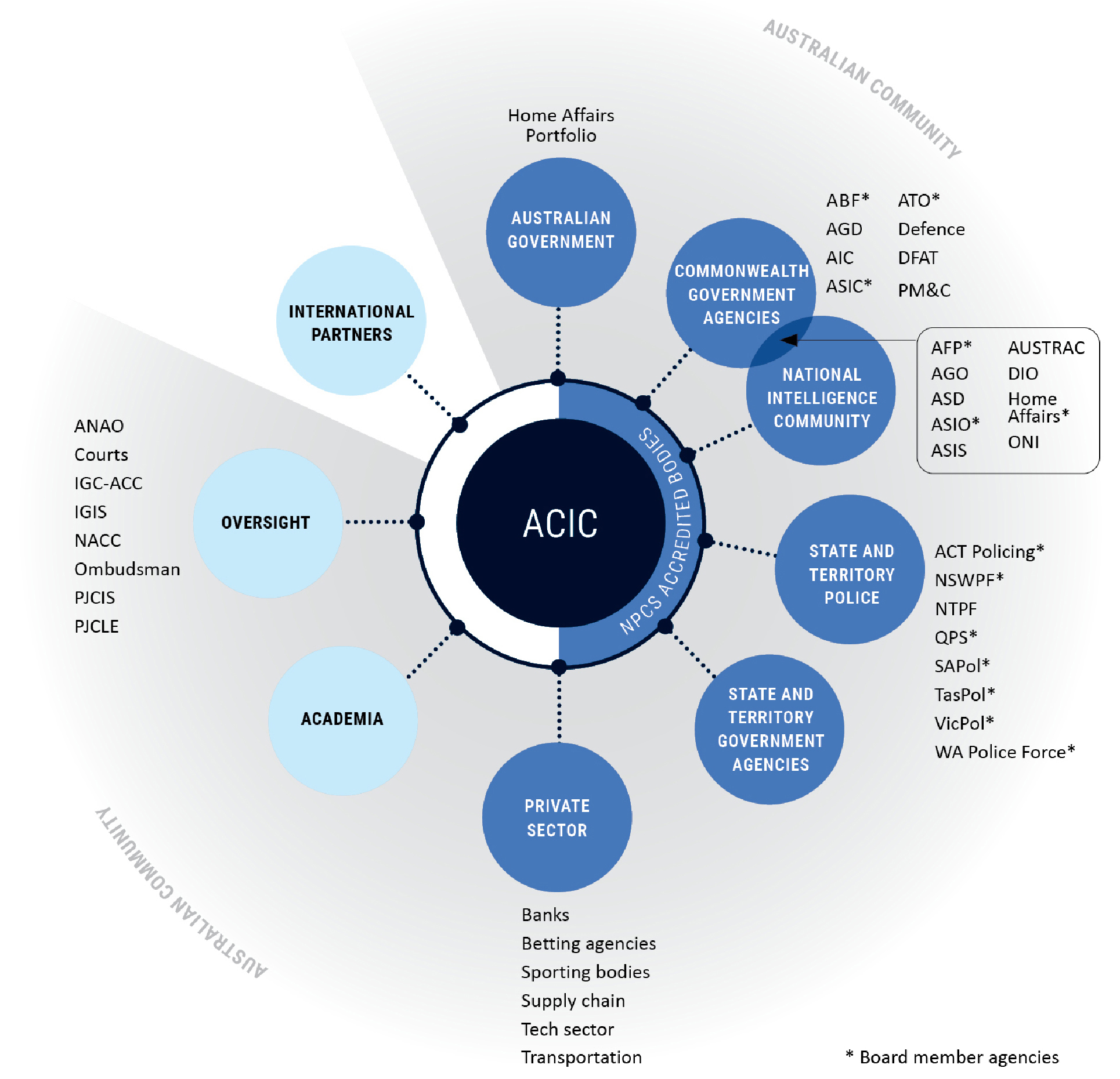
| ABF | Australian Border Force | ATO | Australian Taxation Office | NTPF | Northern Territory Police Force |
| ACT Policing | Australian Capital Territory Policing | AUSTRAC | Australian Transaction Reports and Analysis Centre | ONI | Office of National Intelligence |
| AFP | Australian Federal Police | Defence | Department of Defence | PJCIS | Parliamentary Joint Committee on Intelligence and Security |
| AGD | Attorney-General’s Department | DFAT | Department of Foreign Affairs and Trade | PJCLE | Parliamentary Joint Committee on Law Enforcement |
| AGO | Australian Geospatial-Intelligence Organisation | DIO | Defence Intelligence | PM&C | Department of the Prime Minister and Cabinet |
| AIC | Australian Institute of Criminology | Home Affairs | Department of Home Affairs | QPS | Queensland Police Service |
| ANAO | Australian National Audit Office | IGC-ACC | Inter-Governmental Committee on the Australian Crime Commission | SAPol | South Australia Police |
| ASD | Australian Signals Directorate | IGIS | Inspector-General of Intelligence and Security | TasPol | Tasmania Police |
| ASIC | Australian Securities and Investments Commission | NACC | National Anti-Corruption Commission | VicPol | Victoria Police |
| ASIO | Australian Security Intelligence Organisation | NPCS | National Police Checking Service | WA Police Force | Western Australia Police Force |
| ASIS | Australian Secret Intelligence Service | NSWPF | New South Wales Police Force | ||
Next: Performance