
Accredited Bodies share the ACIC’s commitment to ensuring the safety and security of the Australian community, and are responsible for facilitating organisations and individuals’ access to the National Police Checking Service (NPCS), to apply for a Nationally Coordinated Criminal History Check.
Accreditation applications
The ACIC is pausing the acceptance of NEW applications to become an Accredited Body, from 5 pm AEDT, 4 December 2026.
The Australian Criminal Intelligence Commission Bill 2026 (the Bill) was introduced into Parliament on 25 March 2026. The Bill may change the accreditation process and requirements that apply to Accredited Bodies.
To reduce any financial and administrative impacts the new Bill may have upon interested organisations, the ACIC is pausing the accreditation process and will not accept new applications from 5 pm AEDT, 4 December 2026.
Applications under review
If your organisation has submitted an application, and the outcome has not been finalised, the ACIC will continue to assess your application. You will be notified as soon as practical with the outcome of your application.
Have received an application pack
If you have received an Accredited Body application pack, your organisation will be required to submit all required assessment documentation by 5 pm AEDT 4 December 2026. Applications received after this date will not be assessed.
Exceptional circumstances
Prospective organisations will still be able to apply for accreditation throughout the pause period if there is an exceptional circumstance. Circumstances considered exceptional include organisations undertaking work to support government policy. legislation or community safety.
If your organisation has any questions, please contact the NPCS Accreditation and Audit Team at NPCSAccred@acic.gov.au.
About Accredited Bodies
An Accredited Body is an Australian entity that has been assessed and approved by the ACIC, pursuant to section 46A(5) of the Australian Crime Commission Act 2002 (Cth), to access the Service and submit police checks on behalf of consenting applicants. To facilitate this, Accredited Bodies are entrusted with access to the National Police Checking Service Support System (NSS), in which they can submit check applications and retrieve the results.
Having access to check results supports organisations when determining the suitability of applicants seeking entitlements or being appointed to positions of trust. However, this access comes with a great degree of responsibility surrounding the protection of personal and police information.
The ACIC’s Accredited Bodies comprise of Australian Commonwealth, state and local government agencies, private sector businesses, not-for-profit organisations and Screening Units for those working with children or vulnerable people. These organisations have a direct relationship with the check applicant or the applicant’s employer.
List of all ACIC Accredited Bodies.
Accredited Bodies can submit police checks for a variety of people, for different purposes, depending on their operational function.
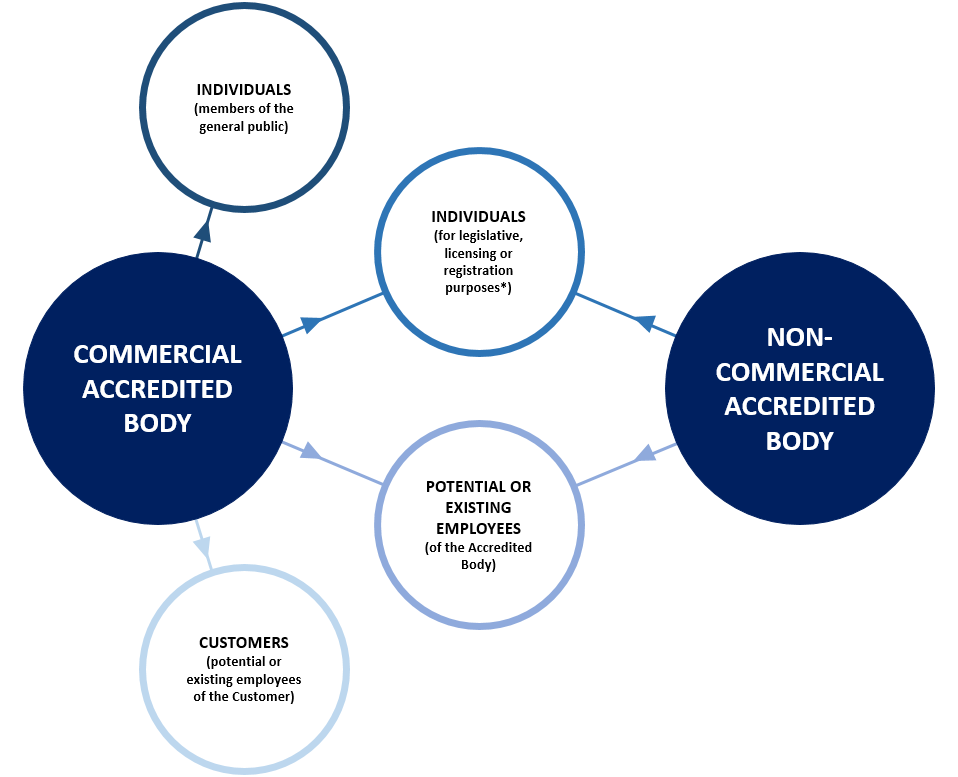
View an accessible text version of this image.
There are 2 types of Accredited Bodies – Commercial and Non-Commercial.
Commercial Accredited Bodies are permitted to submit checks on behalf of individuals for all purposes*, their own potential or existing employees, and for the employees of other organisations (known as Customers) who have been approved by the ACIC. Commercial Accredited Bodies must offer both standard and volunteer checks.
*Please note that the submission of legislative, licensing or registration checks on behalf of individuals is subject to each state and territories’ legislation and regulatory requirements.
Non-Commercial Accredited Bodies are only permitted to submit checks on their own potential or existing employees. Where required by law, they may also submit checks on behalf of individual applicants for legislative, licensing or regulatory purposes. Non-Commercial Accredited Bodies may offer both Standard and Volunteer checks.
Customers
While the ACIC supports third-party commercial arrangements for Commercial Accredited Bodies seeking to service Customers outside of their own organisation, it must also ensure the protection and security of personal and police information.
Access to the Service is subject to the terms of the Agreement for controlled access by duly Accredited Bodies to Nationally Coordinated Criminal History Checks (Agreement), and Commercial Accredited Bodies are only permitted to service organisations who meet the scope and definition of a Customer. Entities who are not accredited with the ACIC are not authorised to access the Service or obtain police checks for use in the community. This is because they have not received the required training that the NPCS provides to its Accredited Bodies on the requirements of the Service and how to correctly complete mandatory fields when submitting checks.
For these reasons, Customers are restricted to requesting checks for their own potential or existing personnel only and are not permitted to on-sell, on-disclose or share check results in full or part (whether verbally, electronically or in writing) with any other third-party, unless required by law. Commercial Accredited Bodies are also not permitted to on-disclose or share check results with any third-party who has not been approved as a Customer by the ACIC prior, unless required by law.
These provisions are set out under the Agreement and have been further strengthened to ensure greater controls and compliance with requirements, which will improve community safety outcomes and the protection of personal and police data.
Entities such as labour hire/recruitment companies who wish to on-sell or on-disclose the results of a check to third-party employers must become accredited with the ACIC and meet the ACIC’s requirements for access to police information. This is to ensure that the ACIC complies with its regulatory responsibilities as the Commonwealth agency responsible for the provision of police checks and maintains adequate oversight over who is accessing the Service and for what purpose.
Accredited Bodies undertake their role in the Service under strict rules and legislative requirements. Therefore, different Accredited Bodies have access to different check categories.
Accredited Bodies cannot provide Working with Children Checks (WWCCs) unless they are a legislated Working with Children Screening Unit and are identified by name in the Intergovernmental Agreement for the Exchange of Criminal History Information for people Working with Children. Similarly, Accredited Bodies cannot provide National Disability Insurance Scheme (NDIS) Worker Screening Checks unless they are an authorised Screening Unit.
With the establishment of Screening Units in each state and territory, police checks no longer contain the vulnerability indicator which stated that the applicant had been assessed as being suitable to have contact with vulnerable people. Accredited Bodies must take all reasonable steps to ensure that their applicants or Customers do not mistake a Standard or Volunteer check for a WWCC or NDIS worker clearance.
Requirements of Accredited Bodies
Accredited Bodies are required to incorporate a number of processes and capabilities into their business to ensure full integration and compliance with the Service. The diagram below summarises the process Accredited Bodies must undertake to participate in the Service.
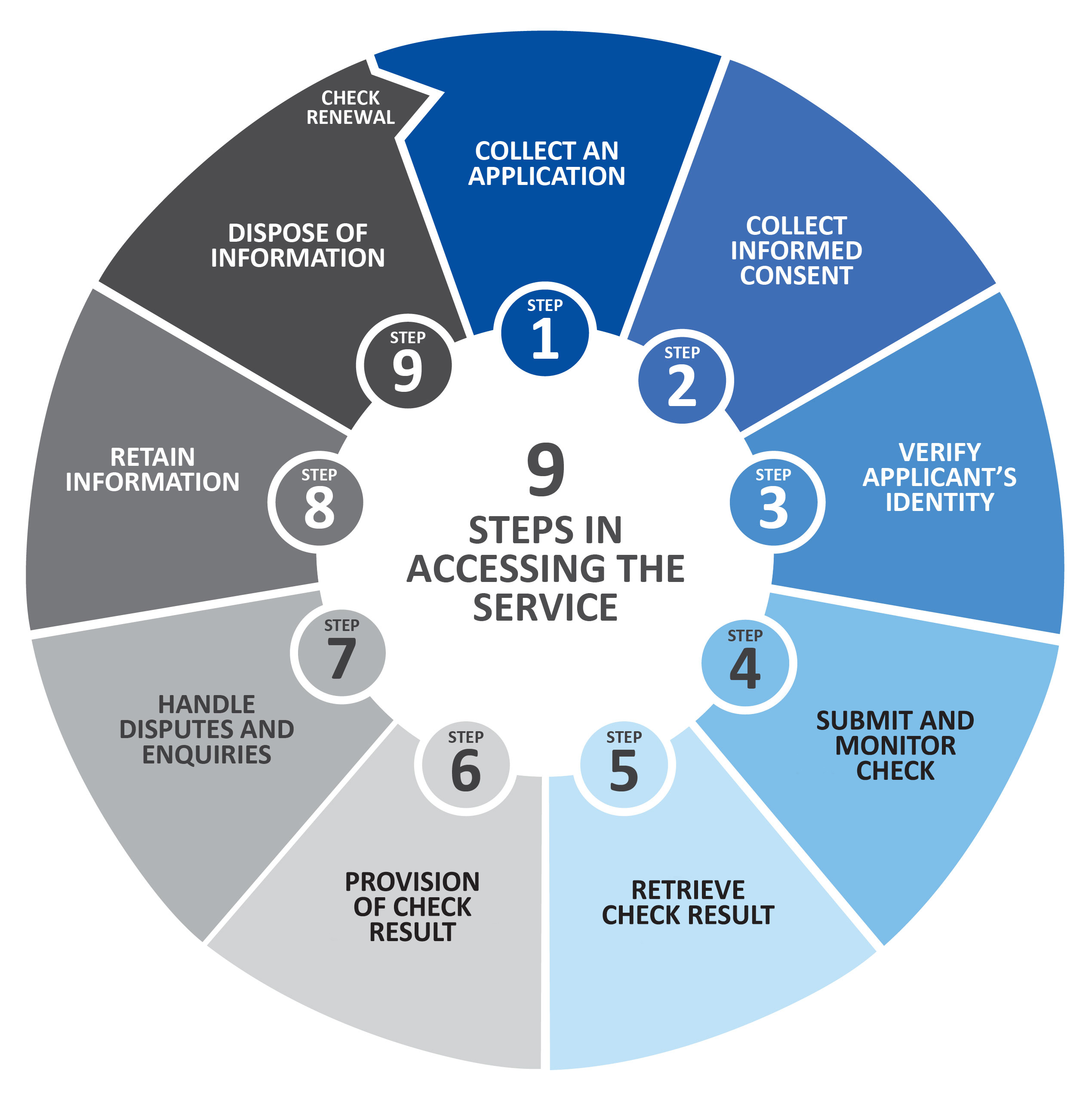
View an accessible text version of this image.
Organisations who have been assessed and found suitable to become an Accredited Body must enter into a legally binding contract (known as the Agreement for controlled access by duly Accredited Bodies to Nationally Coordinated Criminal History Checks) with the ACIC before being granted access to the NPCS Support System (NSS). Through this contract the ACIC governs access to, and use of, the Service by Accredited Bodies as part of its functions provided by the Australian Crime Commission Act 2002 (Cth).
By executing the Agreement, Accredited Bodies confirm their understanding and commitment to comply with the:
- Australian Crime Commission Act 2002 (Cth)
- Privacy Act 1988 (Cth)
- Australian Privacy Principles
- spent conviction schemes
- all terms and conditions of the Agreement, including any guidelines or directions issued by the ACIC over the term of the contract.
All Accredited Bodies must comply with the conditions set out in the Agreement. If an Accredited Body cannot meet their contractual obligations under the Agreement, the ACIC may review their accreditation status and suspend access to the Service, or terminate their Agreement if necessary.
The ACIC administers access to police checks under the Australian Crime Commission Act 2002 (Cth), and abides by all relevant Commonwealth, state and territory legislation relating to the collection, use and disclosure of personal and police information.
Accredited Bodies are entrusted with collecting and storing applicants’ personal information, they must comply with the Privacy Act 1988 (Cth), the Australian Privacy Principles and all other relevant laws.
Accredited Bodies must practice under a written information and communications security policy in order to comply with security standards relating to the protection of sensitive information. Compliance with these standards may require Accredited Bodies to implement a higher level of security and introduce new procedures and protocols into their business.
As part of this the ACIC may request Accredited Bodies to provide evidence of their compliance with relevant areas in the Australian Government’s Protective Security Policy Framework and the Information Security Manual.
More information about security requirements can be found in the Agreement for controlled access by duly Accredited Bodies to Nationally Coordinated Criminal History Checks (Agreement).
Accredited Bodies have direct access to the NSS, which allows their nominated users to submit check applications, monitor check progress, access reports, respond to requests for further information and retrieve results.
Accredited Bodies can choose which of the following methods to use when submitting checks:
- log into the NSS directly and manually enter check data (manual Input)
- log into the NSS directly and upload a file containing a batch of check data (batch upload)
- transmit check data system-to-system via messaging, using either WebSphere MQ or Web Services.
The submission method most suitable for an Accredited Body is dependent on their operational requirements, technical capabilities and check submission volumes.
More information on technical connectivity options and infrastructure requirements are provided as part of the accreditation application process.
While there are no fees for becoming an Accredited Body there are fees associated with submitting checks through the NSS.
- Standard check: $28 each
- Volunteer check: $7 each


